
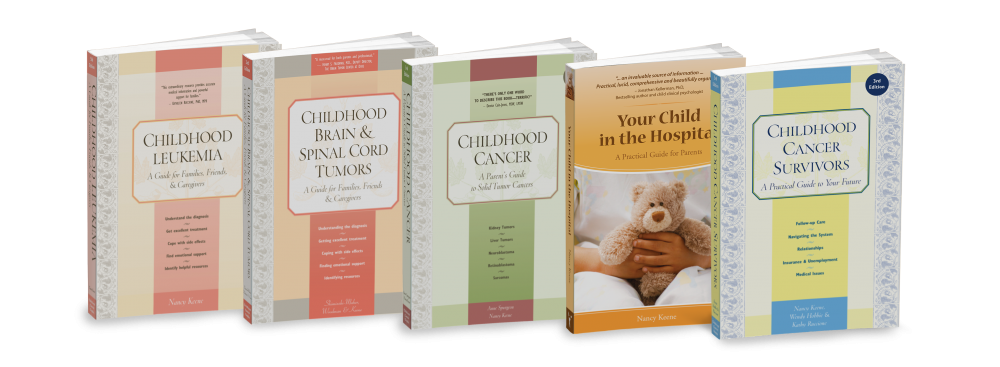
Questions answered. Experiences shared.
ALSF's Childhood Cancer Guides are reviewed by renowned experts in pediatric oncology and feature stories from more than 500 parents, children with cancer, and survivors of childhood cancer. Our hope is to help those following in our footsteps.
These books feature:
- Clear explanations of the various types of childhood cancer
- Descriptions of state-of-the-art treatments for childhood cancers
- Emotional support for every member of the family
- Access to helpful resources
- And more!
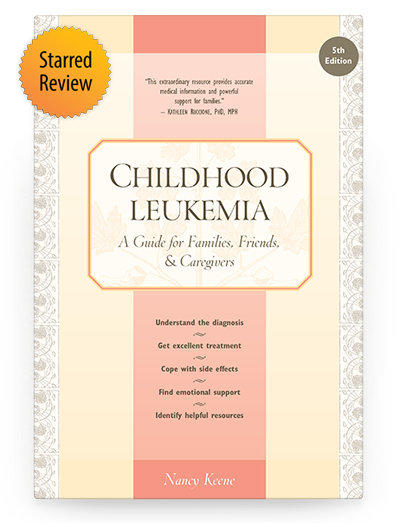
Childhood Leukemia
A Guide for Families, Friends & Caregivers, 5th ed.
By Nancy Keene
Copyright 2018
This comprehensive guide covers acute lymphoblastic leukemia (ALL), acute myeloid leukemia (AML), chronic myelogenous leukemia (CML), and juvenile myelomonocytic leukemia (JMML). It contains essential information that families and friends need after diagnosis, including how to:
- Understand the diagnosis
- Get excellent treatment
- Cope with side effects
- Find emotional support
- Identify helpful resources
After diagnosis, families have a huge need for accurate information and a steep learning curve. To help them cope, our book contains easy-to-understand text that has been reviewed by distinguished experts in childhood cancer. Woven throughout the text are true stories—practical, poignant, moving, funny—from more than 170 children with leukemia, their siblings, and their parents.
Praise for the guide: Childhood Leukemia
“A must-have resource for families of childhood leukemia patients and all library collections.”– Library Journal *starred review*
“This book is an extraordinary resource … the reader will find clear, concise, and understandable information … And even more powerfully, the reader will ‘hear’ the voices of parents who share their experiences.”– Kathy Ruccione, MPH, PhD President, Association of Pediatric Hematology/Oncology Nurses
“Childhood Leukemia is informative, realistic, and accurate. The author handles the topic with transparency, compassion, and a genuine desire to get factual and helpful information into the hands of those going through this disease with their child.”– National Network, newsletter of the Hospital Libraries section of the Medical Library Association
“Childhood Leukemia leaves no stone unturned when helping readers understand what to expect. Using an empathetic approach, it is written in clear, comprehensive language. I recommend that this book become a part of any library’s consumer or health care collection.”– Newsletter of the Nursing and Allied Health Resources (NAHRS) section of the Medical Library Association
“This book offers rock-solid guidance to parents faced with the life-altering news that their child has leukemia. Keene offers guidance and comfort on their difficult journey. This work is highly recommended as a valuable addition to any library.”– Consumer Connection, newsletter of the Consumer & Patient Health Information section (CAPHIS) of the Medial Library Association
“Keene has written a comprehensive handbook to serve as a road map for others, from diagnosis through treatment."– Library Journal, starred review and chosen for ”Nursing Your Children’s Health Collection
“This most complete parent guide available covers not only detailed and precise medical information about leukemia and the various treatment options from chemotherapy to bone marrow transplantation, but also day-to-day practical advice.”– F. Leonard Johnson, M.D. Chief, Division of Pediatric Hematology/Oncology Oregon Health Sciences University
“This wonderful book is an informative addition to the House library, and one we will recommend wholeheartedly. By providing this resource to the children and families staying here, you enable them to find a bit of hope and peace of mind in a time of great difficulty and confusion.”– Peggy Enright, House Director, Boston Ronald McDonald House
“Of all the many kinds of help we had (and we had lots) Childhood Leukemia was the single best gift we received. It was the gift of knowledge, so we could ask intelligent questions about our daughter's care. It was the gift of security, allowing us to foresee much of what was coming, and giving us the tools we needed to cope. And it was the gift of hope, for we could see that many children do, indeed, get through this trying time, and come through the grueling treatment intact.”– Kim Warren, parent of a child with leukemia (one of dozens of thank-you letters sent to the author)
“I am the great grandmother to a little four-year-old girl who...has the type of leukemia known as ALL ... I am 90 years old and was a bookseller for 25 years ... Your book is so complete and so helpful in every way, that I couldn’t resist sending you my compliments for writing it. Bless you.”– Alice H. Sobey (one of dozens of thank-you letters sent to the author)
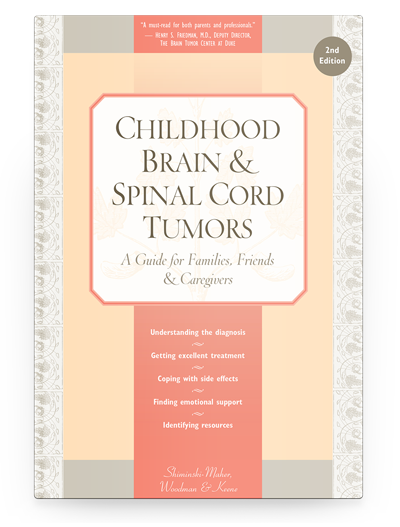
Childhood Brain & Spinal Cord Tumors
A Guide for Family, Friends & Caregivers, 2nd ed.
By Tania Shiminski-Maher, Catherine Woodman, MD, Nancy Keene
Copyright 2014
This comprehensive parent guide covers medulloblastoma, astrocytoma, primitive neuroectodermal tumors (PNET), brainstem gliomas, hypothalamic gliomas, atypical teratoid/rhabdoid tumor (AT/RT), ependymomas, craniopharyngiomas, germ cell tumors, and choroid plexis tumors. It contains essential information that families and friends need during this difficult time, including how to:
- Understand the diagnosis
- Get excellent treatment
- Cope with side effects
- Find emotional support
- Identify helpful resources
Woven throughout the text are true stories—practical, poignant, moving, funny—from more than 120 children with brain or spinal cord tumors, their siblings, and their parents.
Praise for the guide: Childhood Brain & Spinal Cord Tumors
“I really can't say enough good things about this book. It is packed with helpful information that is current, accurate, and written at a level appropriate for most families. I highly recommend it.”– Cancer Librarians Section, Medical Library Association
“For parents, there are few childhood diagnoses more frightening than a brain tumor. This is exactly the book to have in that situation. It maintains a nice balance between providing solid clinical information and sharing stories of emotional support. Highly recommended for all public and health-related libraries.” – Library Journal, starred review and chosen as one of the “Best Consumer Health Books of the Year”
“This guide is a highly valuable resource for families of children with brain and spinal cord tumors. It not only provides reliable and practical information on a wide range of topics that are important for families, but shares essential perspectives and life lessons that best come from parents and children who have traveled these paths before.”– Peter Adamson, MD, Chair, Children’s Oncology Group
“This is a terrific book. It is well-written and easy to read; we recommend it to all who take care of children with these tumors — families and providers.”– Mary-Ann Zimmerman, RN, CPNP, Dana Farber Cancer Institute and Liliana Goumnerova, MD, FAANS, Boston Children’s Hospital
“This is a wonderful resource for newly diagnosed families or those who have been managing a brain or spinal cord tumor for some time.”– Wade Iwata, LMSW, OSW-C, Social worker, Children’s Brain Tumor Foundation, Association of Pediatric Oncology Social Workers
“This book provides an educational, supportive, and practical guide for those affected by the diagnosis of a child's brain or spinal cord tumor. As a physician and a member of a family that has been affected by cancer, I found this book incredibly insightful and valuable.”– Allison King, MD, Washington University Medical Center, St. Louis, Missouri
“A must-read for those working in pediatric neuro-oncology. It is my go-to book to support patients and families dealing with this difficult diagnosis. The book is comprehensive and is given it to all our patients and families.” — Karen Jensen, LCSW, MSW, pediatric oncology social worker, Children’s Hospitals & Clinics of Minnesota
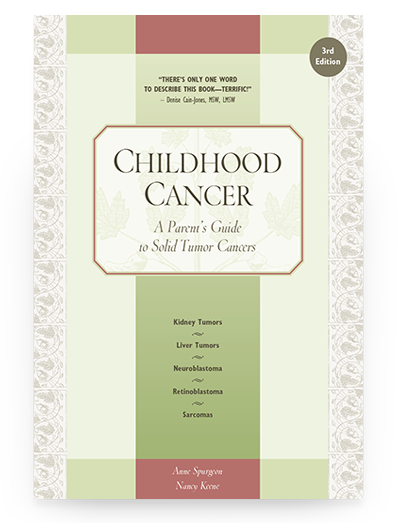
Childhood Cancer
A Parent’s Guide to Solid Tumor Cancers, 3rd ed.
By Anne Spurgeon & Nancy Keene
Copyright 2016
This comprehensive guide covers neuroblastoma, retinoblastoma, Wilms tumor (and other kidney tumors), hepatoblastoma (and other liver tumors), osteosarcoma (and other bone sarcomas), rhabdomyosarcoma (and other soft tissue sarcomas). It contains essential information that families and friends need during this difficult time, including how to:
- Understand the diagnosis
- Get excellent treatment
- Cope with side effects
- Find emotional support
- Identify helpful resources
Woven throughout the text are true stories—practical, poignant, moving, funny—from more than 150 children with solid tumors, their siblings, and their parents. The text was reviewed by renowned experts in pediatric oncology, and the foreword was written by Garrett Brodeur, MD, Co-director of the Division of Oncology, Director of the Center for Childhood Cancer Research, and Director of the Hereditary Cancer Predisposition Program, Children’s Hospital of Philadelphia.
Praise for the guide: Childhood Cancer
“In this latest edition of the esteemed childhood cancer guide, parents of sick children will find the best information available ... VERDICT Comprehensive, encouraging, and pragmatic, this essential title belongs in all libraries.”– Library Journal, *starred* review 9-1-16
“Childhood Cancer is an invaluable resource for any family going through treatment and beyond. It is easy to understand, very thorough, and full of true stories from those who have gone down that scary road. This book is a gem!!”– Denise Maxson, American Childhood Cancer Organization Inland Northwest
“Never have I read a more beautifully written book about cancer. Simply amazing! I have been blessed by reading this priceless book; I cried, I laughed, I was encouraged, and I was further educated.”– Joy McLeod, MS, RN, CPNP, CHIS, The Emily Center Family Health Library at Phoenix Children’s Hospital
“This book should be not only in consumer health collections, it belongs in the hands of all those who care for children diagnosed with cancer. Childhood Cancer provides not just information, it offers wisdom. Highly recommended.”– Kate Cheromcha, Medical Library Association, Cancer Section
“Nancy Keene’s passion to EDUCATE people who are new to childhood cancers is AWESOME!!!”– Jonny Imerman, survivor and founder of Imerman Angels
“This remarkable, outstanding, and comprehensive guide offers rock-solid guidance to parents. A valuable and highly recommended addition to any library.”– Claire B. Joseph, MS, MA, AHIP, Medical Library Association Newsletter
“Childhood Cancer is highly recommended for libraries in children's hospitals and institutions treating children with cancer.”– Deborah Magnan, PT, MLIS, AHIP, Medical Library Association Hospital Library Section Newsletter
“This is one of the most well-crafted, honest and sensitive resources I’ve encountered...I do not believe it is too far of a stretch to say this amazing resource for parents could have meaningful impact on the outcome of a child’s cancer care.”– Ted Varkas, MSW, LMSW, Association of Oncology Social Work Newsletter (AOSW Navigator June 2017)
“This practical guide will empower parents to understand the disease better and participate more actively in the treatment process. Recommended for all consumer health collections.”– Library Journal
“In my 15 years of experience as a pediatric oncology nurse, I have never come across a book as informative, easy-to-read, honest, and encouraging as Childhood Cancer. Childhood Cancer will truly empower those who read it to be better advocates for their children. I am recommending this book to all the pediatric oncology nurses, social workers, and family support personnel I know.” – Pediatrics Special Interest Group Newsletter, Oncology Nursing Society
“Childhood Cancer offers invaluable information and hope to families whose journey has just begun. A must read for parents of children with solid tumors.”– Ruth Hoffman, Executive Director, American Childhood Cancer Organization (formerly Candlelighters Childhood Cancer Foundation)
“Having a child diagnosed with cancer is an emotional time that often leaves a family feeling helpless and without control. Written by parents who have walked in the shadow of childhood cancer, this book provides detailed information, open-armed support, and the arsenal of tools needed to fight the battle that lies ahead.” – Clarke Anderson, M.D., Children’s Center for Cancer and Blood Diseases, Children’s Hospital Los Angeles
“Childhood Cancer is an exceptional resource for parents who are forced to navigate the complex world of childhood cancer. It is invaluable for all family members.”– Eleanor Pask RN, MScN, EdD, Executive Director, Candlelighters Childhood Cancer Foundation ~ Canada
“We are eternally grateful for the invaluable information and advice found in this book! For us, a source of personal knowledge of osteosarcoma is very limited to the general public. … This project is truly a gift of guidance, hope, and comfort. Not only would I recommend it for any one in need, but it definitely should hold a proud place on the book shelf of every pediatric facility.”– Cheryl, Michael, and Shoshana Tobias (one of dozens of thank-you letters received by the authors)
“I am a physician and the parent of a child with cancer. The toll that pediatric cancer takes on families is unquantified, but includes physical and psychiatric illness in the child and in family members, divorce, and tremendous financial stress. Having a resource for coping with all the hardships is the first step toward putting the world back together, and Nancy Keene’s books are the best solution I have found.”– Catherine L. Woodman, MD, and parent of a childhood cancer survivor, University of Iowa, Departments of Psychiatry and Family Medicine
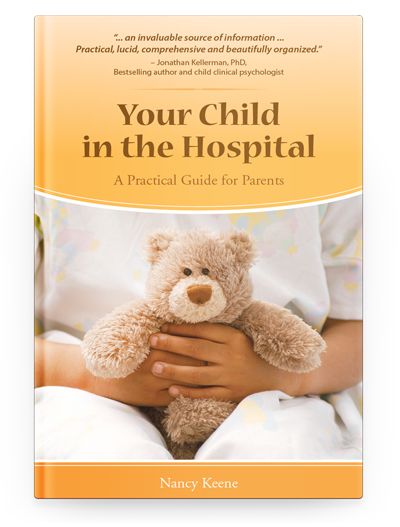
Your Child in the Hospital
A Practical Guide for Parents, 3rd ed.
By Nancy Keene
Copyright 2015
No parent likes to think about their child having to go to the hospital. But it happens—more than 3 million children are hospitalized each year in the United States. Whether a child needs stitches, outpatient surgery, or a long stay in the hospital, Your Child in the Hospital describes how parents can make the most of the facilities, liven up the atmosphere, and even have some fun. It explains how to:
- Prepare your child
- Cope with procedures
- Plan for surgery
- Communicate with doctors
- Deal with bills and insurance
It is also full of sensible tips as well as suggestions about what to pack, helpful books to read beforehand, and even how to get free plane rides for specialty care. Woven throughout the text are dozens of practical and encouraging stories from parents of hospitalized children. When you are packing the stuffed animals and pajamas to take to the hospital, make sure to take this book with you!
Praise for the guide: Your Child in the Hospital
“Your Child in the Hospital is a practical book of tips and wisdom from veteran parents that will help make any hospital stay easier.”– Library Journal, Nursing Your Children’s Health Collection
“Your Child in the Hospital is an invaluable source of information for parents faced with the stress of a child in the hospital. Practical, lucid, comprehensive and beautifully organized.” – Jonathan Kellerman, PhD, Bestselling author and child psychologist
“This is the book that every parent lost in the crisis of a child medical emergency needs. If you have not been spared serious child injury or illness, you will cry with relief when you read it.”– Peggy O’Mara, Editor and Publisher of Mothering Magazine from 1980 to 2011
“Hospitalization can bring unique stresses to children and families. Your Child in the Hospital helps parents to prepare their child emotionally. This is a must read in support of successful outcomes.”– Joseph F. Hagan, MD, Pediatrician and professor of pediatrics, UVM College of Medicine
“This comprehensive book is a must-have for consumer collections.”– Medical Library Association, Consumer and Patient Health Information Section
“Author Nancy Keene included a chapter on school and highlighted the needs of siblings. She has placed the idea back in the minds of parents to include school nurses as part of the healthcare team.”– Deb Ilardi, RN BSN, Clinical Editor, School Nurse News www.schoolnursenews.org
“This slim volume contains a wealth of information in a clear, easy-to-read format … I highly recommend it for all consumer health collections and for parents of children hospitalized for any length of time.”– Medical Library Association, Newsletter of the Cancer Librarians Section
“When you are packing up the stuffed animals and pajamas to take to the hospital, make sure to take this book with you. Chock full of information about how to deal with testing, finances, siblings and schoolwork, this guide is handy and easy to read.”– Atlanta Journal-Constitution
“In a what-to-expect manner, this parent-centered guide offers concrete, useful insights into how hospitals function and how parents can comfortably become part of the process.”– Laura A. Jana, MD, Co-founder, the Dr. Spock Company
“This revised edition of a popular book contains simple, no nonsense advice on how to make hospitalizations easier for the whole family, whether a child is going to the hospital for stitches, outpatient surgery, or a longer stay.”– Our Children, The National PTA Magazine
“When your child is ill or injured, the hospital setting can be overwhelming. Here is a terrific roadmap to help keep families on track.”– James B. Fahner, MD, Division Chief, DeVos Children’s Hospital, Grand Rapids, MI
“In clear, easy-to-read text, this book provides valuable tips to assist both child and parent in coping with any hospital encounter. An excellent resource.”– Oncology Nursing Society
“This is a straightforward, useful book for anyone whose child is facing long-term or short-term hospitalization.”– Parents’ Press
“Written with sensitivity and common sense born of experience and knowledge, it offers solid, practical advice.”– Journal of Child-Care Administration
“For a parent, taking a child to the hospital and facing the uncertainties ahead can also be scary. Your Child in the Hospital is designed to make that time in the hospital a little easier for children and their parents.”– Pittsburgh Post-Gazette
“When their children are in the hospital, panicky parents need support––someone with helping hands and a caring heart. Helpful guidelines are offered in Your Child in the Hospital.”– Nashville Tennessean
“An excellent resource for any parent whose child must be hospitalized. It contains information on preparation for hospital visits, brief procedures and long term illnesses. Stories from parents give first hand advice.”– L.A. Parent
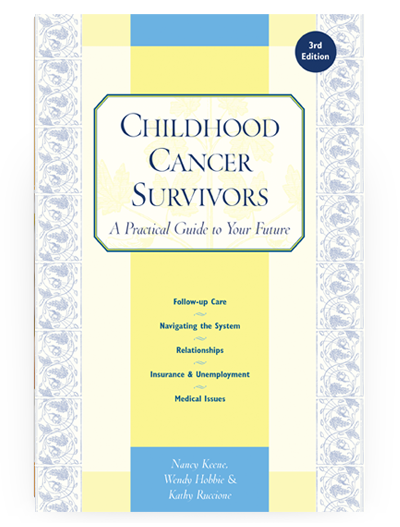
Childhood Cancer Survivors
A Practical Guide to Your Future, 3rd ed.
By Nancy Keene, Wendy Hobbie, Kathy Ruccione
Copyright 2012
More than 420,000 children, teens, and adults in the United States are survivors of childhood cancer. The surgery, radiation, chemotherapy, and stem cell transplants used to cure children can affect growing bodies and developing minds. If survivors know of these potential problems, they can take steps to identify, cope with, or treat them early if they do develop. Childhood Cancer Survivors charts the territory for survivors by providing helpful information about:
- Medical late effects
- Emotions
- Follow-up care
- Staying healthy
- Jobs and insurance
Woven throughout the text are true stories—practical, poignant, moving, funny—from more than 100 survivors of childhood cancer.
Praise for the guide: Childhood Cancer Survivors
“This is a very useful book for both survivors and their families."– Library Journal, starred review and chosen as one of the "Best Consumer Health Books of the Year”
“Survivorship––something every parent whose child with cancer hopes they have to deal with! The good news is that with proper information, follow up, and care, these amazing survivors can fully expect to live happy and productive lives.”– Liz Scott, mother of Alex, Alex’s Lemonade Stand Foundation
“This extraordinary book speaks to all ages as it describes the world of childhood cancer ... In an easy-to-read and well-organized format, the book is packed with facts about the emotional upheavals and drastic changes in both mental and physical health of young patients during treatment and long after the cancer has been cured.” – Surviving: A Cancer Patient Magazine, Stanford Hospital and Clinics
“This book will fill a critical educational gap by providing childhood cancer survivors practical and up-to-date information regarding their cancer and treatment. Perhaps of equal value are the many poignant vignettes that describe the trials and victories of the cancer experience. I consider this book a ‘must read’ for the survivors followed in our long-term follow-up program.” – Kevin C. Oeffinger, MD, Director, Memorial Sloan Kettering's Adult Long-Term Follow-Up Program
“This is a wonderful resource for childhood cancer survivors ... With information comes power, and with the information in this book, childhood cancer survivors will be empowered to take an active role in their life-long medical follow-up. In some cases, this information could be life-saving!”– Wendy Landier, PhD, RN, University of Alabama at Birmingham
“This 456-page paperback is a must-read, must-have not only for any survivors of childhood cancer, family members, caregivers, but also healthcare providers to this courageous population, particularly so for primary care providers and mental health providers...I would order several copies for any patient library or as giveaways for new patients and families.”– Kimberly Lawson, Association of Oncology Social Work Newsletter
“Childhood Cancer Survivors is among eight books sent to LLS chapters this summer for patient services managers and other chapter staff to use for their own reference or to recommend or loan to patients and caregivers.”– eNewsLine, Leukemia and Lymphoma Society
“Early treatment and detection is key to protecting the life you fought hard to save, say the creators of Childhood Cancer Survivors: A Practical Guide to Your Future. The third edition of the guide was released in July, with potentially life-saving tips for the estimated 60 percent of pediatric cancer patients who will have to cope with medical late effects of treatment.”– Hope Chest Newsletter, Children’s Neuroblastoma Cancer Foundation
How to Use the Childhood Cancer Guides
While conducting research for this book, we were repeatedly told by parents to “write the truth.” Because the “truth” varies for each person, more than 100 parents, children with brain or spinal cord tumors, and their siblings share portions of their experiences. This book is full of these snapshots in time, some of which may be hard to read, especially by families of newly diagnosed children. Here are our suggestions for a positive way to use the information contained in this book:
Consider reading only the sections that apply to the present or the immediate future. Even if your child’s prognosis indicates a high probability of a cure, reading about recurrence or bereavement can be emotionally difficult.
Realize that only a fraction of the problems that parents describe will affect your child. Every child is different; every child sails smoothly through some portions of treatment but encounters difficulties during others. The more you understand the variability of cancer experiences, the better you will be able to cope with your own situation, as well as be a good listener and helpful friend to other families you meet with differing diagnoses and circumstances.
Take any concerns or questions that arise to your pediatric oncologist and/or nurse practitioner for answers. The more you learn, the better you can advocate for your child.
Share this book with family and friends. Usually, they want to help, but don't know what to do. The childhood cancer-specific guides not only explains the disease and treatment but also offers dozens of concrete suggestions for family and friends.
If you want to delve into any topic in greater depth, Appendix C, Books and Websites, is a good place to start. It contains a list of reputable websites and an extensive list of books for parents and children of all ages. Your taste in reading materials is very individualized, so if something suggested in the appendix is not helpful or upsets you, feel free to try another resource.